


Built for the Way Support Coordinators Actually Work.
- Client
- Ability Links
- Founder
- Mark Pietsch
- Industry
- NDIS/ Disablitiy Services
- Location
- Sydney, AU
- Timeline
- 5 Months MVP
About Ability Links
Ability Links is a Sydney-based NDIS support coordination practice led by Mark Pietsch — a Regional Support Coordinator who helps people with disabilities navigate their NDIS plans, access services, and get the most out of their funding. Support coordination is nuanced, relationship-heavy work: understanding what a participant needs, identifying the right providers, managing budgets across three separate NDIS funding categories, and staying across every plan, every check-in, and every service agreement — for every person on the caseload.
Mark runs a team. And like most support coordination teams across Australia, that team was running on spreadsheets.
The Problem: Five Spreadsheets Where There Should Be One System
NDIS support coordination generates a lot of information. Participant details. Plan dates and budgets. Service agreements. Check-in logs. Provider contacts. Documents. Progress notes. For a team carrying a real caseload, that information needs to be accessible, accurate, and shared — so that anyone on the team can pick up where someone else left off.
Ability Links wasn't there. Participant data lived in one spreadsheet, plan budgets in another, check-in logs somewhere else. The team discussed updates verbally and hoped everyone was working from the same version. Nothing automated. Nothing connected. Coordination work — work that is supposed to help people — was generating its own coordination overhead.
Before Working With Us
The tools on the market weren't built for this either. The software that existed was built for support workers — the people delivering hands-on services — not support coordinators, whose job is to manage the whole picture. Mark had explored generic options. None of them fit the workflow. None of them understood the NDIS funding structure. None of them handled the three-tier budget model — Core, Capacity, Capital — that every support coordinator works with every day.
No off-the-shelf software was built for NDIS support coordinators specifically. The team needed a system that understood their workflow — participant plans, NDIS budget categories, service tracking, check-in logs — not a generic CRM adapted to fit.
Before Working With Us
Building Appulse: One Platform for the Whole Caseload
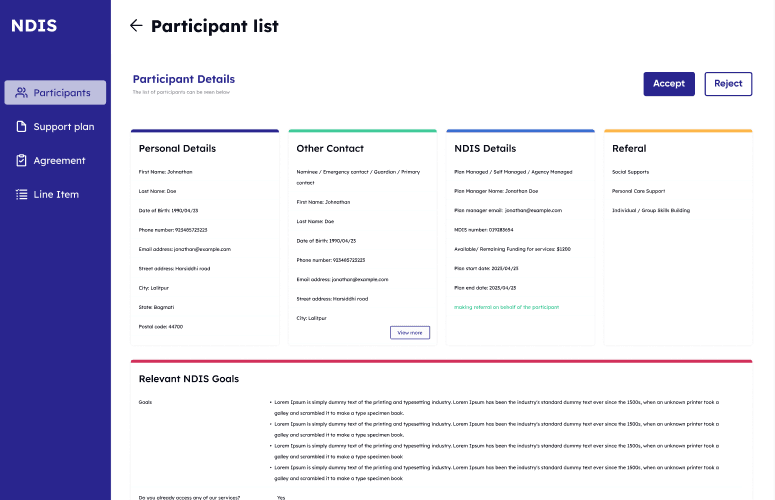
We started where we always start — mapping the actual workflow before scoping a single screen. Support coordination has a clear shape: an initial plan, services attached to that plan, ongoing check-ins, documents, contacts, and a budget that needs to be tracked against NDIS funding categories without ever going over. Every feature in Appulse exists because a specific step in that workflow required it.
The MVP was scoped to cover the full operational core — everything a support coordinator needs to run their caseload from day one, without the features that could wait. In five months, Lean Q designed and built that platform end-to-end.
For the first time, the whole team is looking at the same thing. Not a spreadsheet version from Tuesday — the actual, live picture of every participant, every plan, every service.
Participant Profiles
Full profiles with personal details, NDIS and Medicare numbers, health conditions, emergency contacts, and tags. Everything about a participant in one place.
NDIS Plan & Budget Management
Plan dates, days remaining, and budgets split across Core, Capacity, and Capital support categories — matching the NDIS funding structure exactly.
Service Tracking
Services linked to each plan with management type (NDIA, Plan, or Self Managed), budget amounts, charge items from the NDIS price guide, and assigned coordinators.
Check-In Notes
Logged by contact type — phone, SMS, email, face-to-face, teleconsult. Every interaction on record, timestamped, and visible to the whole team.
Document Management
Upload, categorise, and manage participant documents — service agreements, reports, referrals — with view, download, and delete controls.
Contacts: Two-Level System
Manage both individual contacts and organisations — with relationship types, roles, and links back to relevant participants and services.
Projects & Tasks
Assign projects and task lists to participants and team members — turning complex, multi-step support work into trackable, accountable workflows.
Role-Based Access Control
Custom roles with granular permissions — so coordinators, administrators, and managers each see exactly what they need to, and nothing they shouldn't.
During the build
Compliance by Design, Not by Accident
NDIS participant data is sensitive. There's no ambiguity there — these are people's health conditions, care histories, and financial details. Any software handling it needs to be hosted on Australian soil, built with security from the ground up, not retrofitted.
Appulse is hosted on AWS Sydney. The data model was architected for ISO 27001 alignment from day one — not patched in later. Every piece of participant data stays in Australia. For Mark and his team, that wasn't a feature request. It was a requirement. It's in the build spec, not the roadmap.
Mark Pietsch
What's Next for Appulse
The MVP covers the operational core. The roadmap — already scoped — extends it into the things that will turn Appulse from a case management tool into a full practice management platform.
Next: an invoicing engine that handles all three NDIS management types — Agency Managed (CSV export to NDIS), Plan Managed (invoices to bookkeeper), and Self Managed (invoices direct to participant) — with Xero integration for automated tracking. After that: a VoIP integration that automatically surfaces participant profiles on incoming calls and logs call duration against the right service. Then: portals for participants and service providers, and referral forms that auto-populate from participant profiles.
The foundation is built for it. Every module was architected to connect — participant profiles linked to plans, plans to services, services to budgets and charge items. The MVP wasn't a prototype. It was the platform.
After working with us